How much is your home worth?
Generate a free property report instantly OR
arrange an accurate market appraisal.

On the Plaistow property market, the best streets are usually those close to Plaistow Underground station, catchments of the most sought-after local schools, and roads seeing the benefit of regeneration over the past few years.
But a little local knowledge is key to buying the right property in this part of town. With a changing property scene like Plaistow’s, you need to understand where each location fits into the picture now – and what’s coming next.
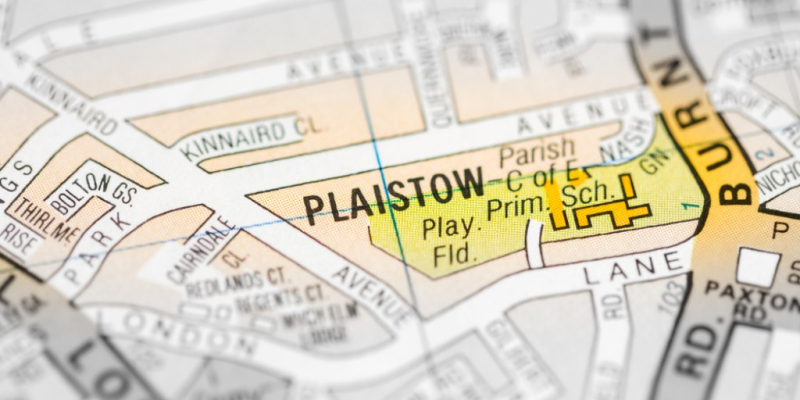
Whilst Plaistow is not defined by the luxury property market, certain streets still consistently attract higher prices and rarely see a property sit vacant for long. These roads tend to combine good period housing with short walks to the station or West Ham Park, and several sit within the catchment boundaries of schools that draw buyers from across the borough.
For flats, look around the station itself and near Barking Road where newer conversions and purpose-built blocks have the potential to offer good rental yields. These are not premium streets in the traditional sense, but they are consistently active markets.
Plaistow breaks down into these areas, from the quieter Victorian terraces to purpose-built flats near the station that are ideal for commuters.
| Zone | Character | Who it suits | Price indicator |
|---|---|---|---|
| Plaistow station area | High footfall, strong transport links, mix of period terraces and newer flats | Commuters, buy-to-let investors, first-time buyers | Mid-to-upper range for E13 |
| South Plaistow residential streets | Quieter streets, larger Victorian and Edwardian terraces, more family-oriented | Families, owner-occupiers upsizing from flats | Upper range for the area |
| Barking Road area | Busy arterial, commercial ground floors, flat-heavy upper floors | Investors, tenants prioritising convenience | Mid-range; stronger on yield than capital value |
| West Ham Park area | Green space adjacency, quieter roads, desirable school catchments | Families, long-term owner-occupiers | Premium within Plaistow |
| East Plaistow/Upton Park | Transition zone, mixed tenure, some regeneration activity | Value-focused buyers, investors watching the regeneration pipeline | Lower-to-mid range currently |
School catchments. Catchment boundaries and distance from your home to the school can make a real difference to your admissions chances for oversubscribed schools. Popular local schools include the Ofsted Outstanding-rated Portway Primary School on Stratford Road and New City Primary School on Tunmarsh Lane, but ratings can vary and there are many options within Newham. Check current Ofsted ratings and review the current year’s catchment boundaries with Newham Council.
Transport proximity. Plaistow station is on the District and Hammersmith & City lines that can see 7,000 daily entries as per TfL data. Streets within a ten-minute walk of the station can command a premium over those a bus ride away, and this busy station could receive more attention in future. Transport for London shortlisted the Plaistow for a step-free access study, and if that scheme progresses, streets in the immediate area may benefit from improved footfall and accessibility.
Plaistow sits within the E13 postcode, where average house prices sit just below £400,000 by Rightmove estimates. Actual house prices vary by property size and type, and their location, breaking down roughly as follows:
| Zone or street type | Property type | Approximate price range |
|---|---|---|
| Plaistow station area | Victorian terraced house | £380,000 to £480,000 |
| South Plaistow residential streets | Larger Victorian/Edwardian terrace | £420,000 to £550,000 |
| West Ham Park area | Mid-terrace or semi-detached | £450,000 to £580,000 |
| Barking Road area | Flat (purpose-built or conversion) | £220,000 to £320,000 |
| East Plaistow/Upton Park | Terraced house (mixed condition) | £320,000 to £430,000 |
As in surrounding parts of East London, Plaistow house prices tend to rest on proximity to the Underground, garden size, condition, and whether the property sits on a road with through-traffic or on a quieter residential street. Broad, leafy streets can also make a positive impression on buyers, leading to higher house prices.
Parking availability is also a factor in Plaistow. Public transport access may be excellent, but on streets without controlled parking zones, off-street parking can still add value for buyers with cars.
The east Plaistow streets running towards Upton Park have historically sold for lower prices than those by the station. Some of that discount is justified, with their less even presentation and a longer walk to Plaistow station.
But buyers who are prepared to factor in the proximity to Upton Park station on Green Street, which is also served by the District and Hammersmith & City lines, may find that the transport access is pretty similar, for noticeably lower prices.
Streets like Vicarage Lane can offer decent homes close to the Stratford border, for lower prices because they’re not immediately obvious to buyers outside the area.
Plaistow’s residential streets are predominantly Victorian and Edwardian in origin, harking back to the late 19th and early 20th Centuries’ influx of workers. As you’ll find in many areas with a similar past, these houses are two-up two-down terraces on the narrower streets. Wider roads also have their share of larger bay-fronted terraces, with occasional semi-detached pairs to be found.
The south Plaistow area retains some of the best-preserved examples of these, with bay windows on the ground and first floor, original brickwork and longer gardens. You may even find houses with original tiled paths and period front doors, though these are becoming increasingly rare.
Around Barking Road, buyers will find a wider mix of architectural styles, from the purpose-built flat blocks of the 1960s and 1970s to converted Victorian terraces. Buyers looking for period features should inspect carefully, as many Plaistow conversions were carried out before current standards for retaining original features became usual. Conversion quality can vary quite a bit, making a good survey essential to your purchase.
Newer developments bring in a newer style, like the Plaistow Hub with its commercial ground floors and a new public square. This has changed the face of the station area, giving it a decidedly contemporary twist. For a detailed treatment of Plaistow’s property types, internal layouts, and what to look for when inspecting period stock in E13, see the companion Property & Architecture guide.
Want to know more? Read about living in Plaistow and compare the property types available in East London.
Plaistow has a higher proportion of private rented households than the London average, as confirmed by ONS census data, and Plaistow is no exception. This reflects its position as an affordable entry point to inner East London, with strong transport links.
The rental concentration is highest along the Barking Road area and the streets immediately around the station, where purpose-built flats and converted terraces are most often let rather than owner-occupied. South Plaistow is more evenly split, with owner-occupiers often being drawn by the larger houses and the family-oriented atmosphere of the streets. The West Ham Park area leans towards owner-occupation, with buyers who pay a premium for park views tending to be long-term residents rather than investors.
| Zone or street type | Predominant tenure | Typical buyer or tenant profile |
|---|---|---|
| Station and Barking Road area | Mixed, skewing to private rented | Investors; tenants prioritising commute convenience |
| South Plaistow residential streets | Mixed, skewing to owner-occupied | Families; upsizing owner-occupiers |
| West Ham Park area | Predominantly owner-occupied | Long-term owner-occupiers; family buyers |
| East Plaistow area | Mixed; higher investor activity | Value-focused investors; tenants on mid-range budgets |
The Plaistow Hub has delivered 182 market-rent apartments, commercial space, and a new public square on the two sites either side of Plaistow Underground station. This has modernised the public spaces here, with nearby streets like Balaam Street and those south of the Barking Road junction seeing the benefit.
Newham Council’s five-year Growth Plan for 2025 to 2030 identifies up to 8,000 new homes on council-owned land across the borough. Not all of that pipeline falls within Plaistow, but schemes of this demonstrate that there’s ongoing investment in the borough’s infrastructure. That can benefit residents in surrounding parts of the borough.
Transport for London’s 2025 shortlisting of Plaistow station for step-free access works is the other development worth tracking. If the feasibility study concludes positively and the scheme is funded, the station will become significantly more accessible – a much-needed update which tends to broaden the pool of potential tenants and buyers for nearby streets. Streets within the immediate station catchment area are the ones to watch if that announcement comes through.
Having worked through the pockets, price drivers, and development pipeline in Plaistow, the practical next step is a conversation with an agent who operates in E13 day to day. Whether you have identified a specific street or are still weighing up which part of Plaistow suits your needs, we can help narrow it down. Contact us to discuss what’s available, or register as a buyer or tenant to be matched with properties as they come to market.
Streets close to Plaistow Underground station, such as Balaam Street, consistently attract strong demand and reliable resale values. For families, the south Plaistow residential grid and roads bordering West Ham Park offer larger period houses with better school catchment access. The best street depends on whether you are prioritising transport, family amenity, or investment yield.
The main price drivers in Plaistow are proximity to the Underground station, road width, garden size, proximity to West Ham Park, and school catchment. Streets that combine strong transport access with park adjacency or a sought-after catchment consistently achieve the highest prices within the E13 postcode.
The east Plaistow streets around Vicarage Lane towards the Upton Park boundary, can sell for lower prices considering their fairly good transport access. We will be glad to advise on currently up-and-coming streets as the picture evolves in Plaistow.
Plaistow’s residential streets are not within a designated conservation area, unlike some neighbouring parts of Newham. This means permitted development rights are broader, which can benefit buyers planning extensions, but also means the period streetscape has less formal protection against future change by other property owners.
Plaistow offers solid fundamentals for buy-to-let buyers, with reliable tenant demand including on well-presented home snear the station, and purchase prices below comparable streets in Forest Gate or Stratford. Investors focused on yield tend to find the east Plaistow fringe more attractive, while those prioritising capital value focus on the station-adjacent core and the West Ham Park fringe.
Generate a free property report instantly OR
arrange an accurate market appraisal.
We’re here to help with any property-related queries you may have.
"*" indicates required fields


Plaistow's Hidden Property Gem: What Buyers Need to Know Before They Buy Street after street of intact Victorian terraces, just minutes ...

Is Plaistow East London's Best-Kept Secret? Whilst Stratford's property prices have soared beyond reach for many buyers, neighbouring Pl...
Nineteen minutes to Liverpool Street. Average property prices around £396,000. If those two facts sitting side by side surprise you, you'...